
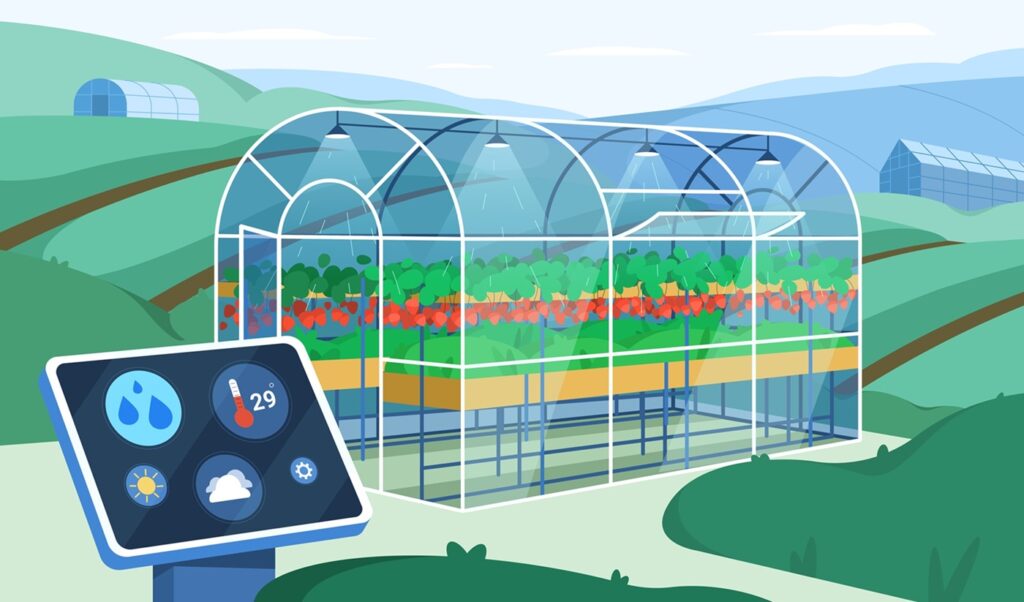
Walk into a modern greenhouse or a well-managed cold storage facility today, and you’ll notice something interesting. The biggest improvements are not always visible. There may be no dramatic new machinery or flashy robotics in sight. Instead, the real change is happening quietly through data.
Temperature trends. Humidity curves. CO₂ levels. Light intensity patterns.
These four parameters alone are reshaping how growers, storage managers, and food businesses protect quality and maximize output. And yet, many operations are still relying on manual checks, outdated loggers, or worse gut feeling.
If your business depends on maintaining the right environment, real-time monitoring is no longer a luxury. It’s becoming the difference between predictable profit and avoidable loss.
Let’s unpack why.
The Hidden Cost of “Almost Right” Conditions
In agriculture and food systems, things rarely fail dramatically. They drift.
- A cold room runs 2–3°C warmer than intended overnight
- A greenhouse humidity spike goes unnoticed for six hours
- CO₂ drops below optimal levels during peak photosynthesis
- Light intensity varies across growing zones
Individually, these may seem minor. Collectively, they compound into:
- Reduced crop yield
- Inconsistent quality
- Shorter shelf life
- Higher spoilage rates
- Failed compliance audits
The uncomfortable truth is that most losses in controlled environments don’t come from catastrophic failures. They come from small deviations that go unnoticed for too long.
This is exactly where continuous environmental monitoring creates outsized value.
Why the Four Core Parameters Matter More Than Most People Think
Many facility owners assume monitoring temperature alone is sufficient. In reality, modern controlled environments behave like living systems where multiple variables interact.
Temperature: The Obvious but Often Mismanaged Variable
Temperature remains the primary driver of biological and chemical activity. Whether you’re storing apples or growing lettuce, even brief temperature excursions can accelerate respiration, microbial growth, or plant stress.
What many operators miss is temperature variability across zones. A single wall-mounted sensor rarely tells the full story. Stratification, door openings, and equipment cycling create microclimates that only multi-point monitoring can reveal.
Relative Humidity: The Silent Quality Killer
Humidity is frequently under-monitored, yet it directly influences:
- Transpiration rates in plants
- Fungal growth risk
- Condensation inside storage rooms
- Product weight loss during storage
Too low, and produce dehydrates. Too high, and mold risk rises sharply.
The real challenge is that humidity problems often become visible only after damage has begun. By the time you see condensation or spoilage, the environment has already been out of range for hours or days.
Continuous RH tracking gives operators the early warning they rarely get from manual inspection.
CO₂: The Underutilized Lever in Controlled Growing
In hydroponics, vertical farming, and greenhouses, CO₂ is not just a measurement, it’s a productivity lever.
When CO₂ levels fall below optimal ranges:
- Photosynthesis slows
- Growth rates drop
- Yield potential is left on the table
Many growers invest heavily in lighting and nutrients while overlooking CO₂ stability. Without real-time visibility, enrichment systems often run inefficiently, leading to wasted gas or suboptimal plant performance.
Monitoring transforms CO₂ from a guessing game into a controllable input.
Light Intensity: More Than Just “Lights On or Off”
Light is the engine of plant growth, but uniformity matters just as much as intensity.
In multi-layer farms or large greenhouses, light distribution is rarely even. Fixtures age, shadows shift, and canopy density changes over time. Without measurement, operators are effectively flying blind.
Tracking light intensity helps answer practical questions:
- Are all zones receiving adequate PPFD?
- Are fixtures degrading over time?
- Is energy being wasted on over-lighting certain areas?
These insights directly translate into better crop consistency and smarter energy use.
Where Real-Time Monitoring Delivers Immediate ROI
While environmental monitoring has broad applications, a few sectors consistently see rapid payback.
Hydroponic and Vertical Farms
Controlled environment agriculture depends heavily on environmental precision. Small improvements in climate stability often translate into measurable yield gains.
Typical benefits include:
- Faster crop cycles
- More uniform growth
- Reduced disease pressure
- Better resource efficiency
Because these operations are already technology-forward, adoption tends to be smoother and ROI easier to demonstrate.
Cold Storage and Post-Harvest Facilities
For storage operators, the value proposition is often even clearer: prevent loss.
A single unnoticed temperature excursion can damage inventory worth thousands sometimes far more. Continuous monitoring provides:
- Real-time alerts
- Historical audit logs
- Compliance support
- Peace of mind during off-hours
Many operators only realize the importance of monitoring after experiencing a costly incident. Proactive deployment changes that equation entirely.
Mushroom Farms: A High-Sensitivity Niche
Mushroom cultivation is particularly sensitive to environmental fluctuations. CO₂ buildup, humidity swings, and temperature drift can quickly impact yield and quality.
Because margins are often tight and conditions must be tightly controlled, mushroom growers are among the most responsive adopters of real-time monitoring when shown clear data benefits.
From Data to Decisions: Why Dashboards and Alerts Matter
Sensors alone don’t create value. Visibility does.
The real power of modern monitoring systems lies in turning raw measurements into actionable insights:
- Live dashboards showing current conditions
- Historical graphs revealing trends
- Threshold alerts via SMS, email, or messaging apps
- Multi-location comparison views
When implemented well, operators move from reactive firefighting to proactive management.
Instead of discovering problems during morning rounds, they know about deviations the moment they occur even at 2 AM.
The Rise of Expandable Monitoring Platforms
One of the biggest shifts in recent years is the move toward modular monitoring systems.
Forward-looking operations no longer want single-purpose devices. They prefer platforms that can grow with their needs.
A typical deployment might start with:
- Temperature
- Relative humidity
- CO₂
- Light
But over time, many facilities choose to add:
- Soil moisture
- EC and pH
- Ethylene (for ripening and storage)
- Differential pressure
- Energy monitoring
Expandable systems protect the initial investment while allowing facilities to evolve toward deeper automation and analytics.
What Smart Operators Are Doing Differently
Across agriculture and food systems, a pattern is emerging. The most efficient operations share a few common habits:
- They monitor continuously, not periodically
- They track multiple environmental variables together
- They rely on alerts instead of manual checks
- They maintain historical records for analysis
- They design systems that can scale over time
This shift is subtle but powerful. It turns environmental control from a reactive chore into a strategic advantage.
Looking Ahead: Monitoring as the Foundation for Automation
Environmental monitoring is often the first step toward full automation.
Once reliable data is available, facilities can begin layering in:
- Automated ventilation control
- Smart irrigation triggers
- CO₂ enrichment control
- Adaptive lighting schedules
- Predictive maintenance alerts
In this sense, monitoring is not the end goal it is the foundation.
Operations that invest early in high-quality sensing infrastructure position themselves to adopt automation far more smoothly down the road.
Final Thoughts
Agriculture and food systems are entering a phase where precision is no longer optional. Margins are tighter, quality expectations are higher, and environmental variability is increasing.
Real-time monitoring of temperature, humidity, CO₂, and light may seem simple on the surface. But in practice, it delivers something every operator values: visibility and control.
For facilities still relying on manual checks or isolated data loggers, the opportunity is clear. The technology is mature, the economics are proven, and the competitive advantage is real.
Sometimes, the most impactful upgrades are the quiet ones the systems that watch continuously, alert early, and help prevent problems before they become losses.
And in modern controlled environments, that quiet layer of intelligence is quickly becoming indispensable.